
Getting started with Audit
Use this section to understand the workflows, connections, and associated sections within the Audit app.
Workflow
The workflow below describes the lifecycle of the core Audit objects. For more information about objects and the object library, go to Object library.
An Audit object lifecycle from start to finish:
-
Auditable entity
-
Audit risk assessment
-
Audit plan
-
Audit
-
Control assessment (also known as control tests which leads to producing Audit findings and remediation Actions)
Connections
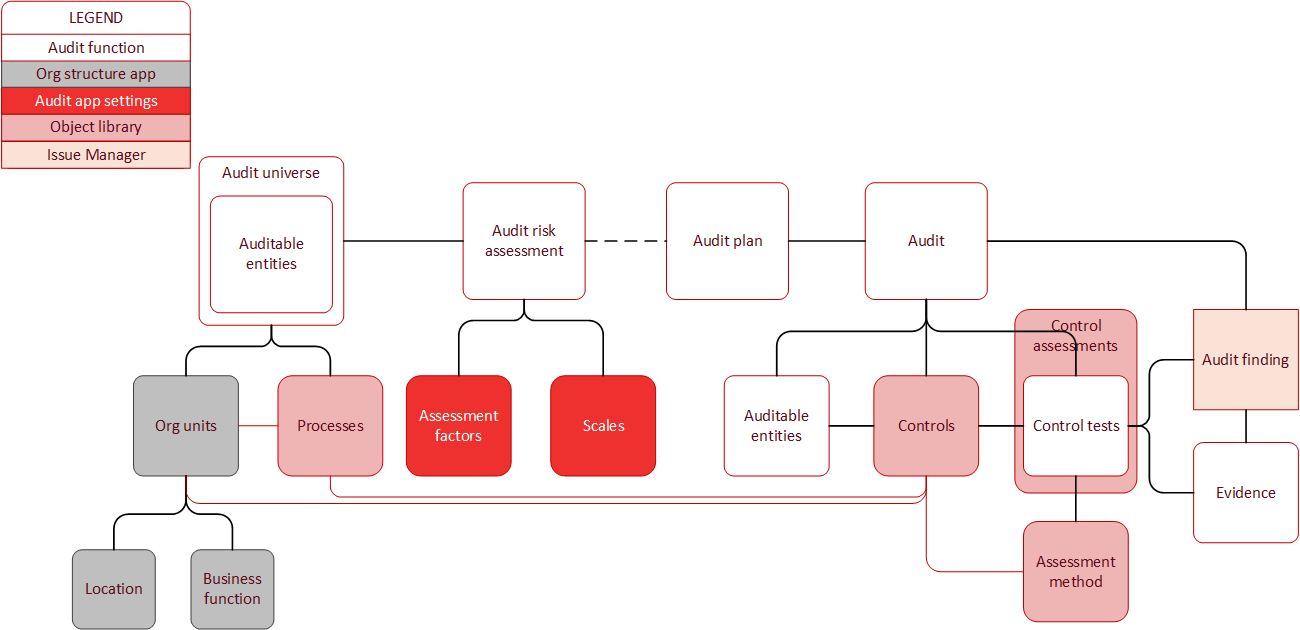
To get an understanding of the connections between the functions, objects, and the sections of the app, see the Audit connections diagram below.
Note
Lines between functions, objects, and app sections indicate the type of connection:
-
A solid black line indicates a general direct connection.
-
A solid red line indicates a connection through the Object library section.
-
A dashed line between Audit risk assessment and Audit plan indicates that an audit plan can be created without an audit risk assessment.
Accessing Audit
-
To access the Audit app, sign in to the Diligent One Platform.
-
On the Launchpad home page, under Audit & Analytics, select Audit. The Audit home page appears.
Navigating the home page
Use the home page widgets and navigation menu to access and manage work in the Audit app. Certain widgets and user interface elements are only available for specific roles. These options are explained in the table below.
Note
Select the Diligent icon  to go to the Diligent One Platform launchpad.
| UI element | Role | Description |
|---|---|---|
| Navigation menu | All | Select the Navigation menu icon  to expand or collapse the navigation menu. to expand or collapse the navigation menu. |
| Home | All | Select the return icon  from any page in Audit to go back to the home page. from any page in Audit to go back to the home page. |
| Recent activity | All | View recent activity you can select to return to items you were working on. |
| Overview | All |
View role-based overview dashboard. The panels and layout vary by your role, such as Head of Audit, Audit Manager, Auditor, or Audit QA. |
| Filters | Head of Audit or Audit Manager | Filter dashboard data by location or auditable entity. |
| Export to PDF | Head of Audit or Audit Manager | Export your current dashboard view to PDF for reporting and sharing. |
| Audit plans | Head of Audit or Audit Manager |
View the audit plans currently in progress. Select the name of an audit plan to open it in Audit planning. Select Audits within an audit plan to open a side panel of the audits for that plan. Select View all in the Audit plans section to go to the Audit planning page where you can add and manage audit plans. |
|
Audits |
Head of Audit or Audit Manager |
View the audits currently in progress or closed, organized by due date, and filter the audits by their current status. Select the name of an audit to open it in Audit fieldwork. Select Control tests within an audit to open a side panel of the control tests for that audit. Select View all in the Audits section to go to the Audit fieldwork page where you can add, plan, perform, and complete your audit engagements. |
| Assignments | Auditor |
View all audit engagement related tasks assigned to you. Select Control tests within an audit to open a side panel of the control tests for that audit. Select the name of an audit to open it in Audit fieldwork. Select View all in the Assignments section to go to the Audit fieldwork page where you can see all audit engagements. |
| Findings | Head of Audit or Audit Manager |
View any findings not in a draft state, organized by due date, and filter the findings by their current status. Select the name of a finding to open it in Object library. Select View all in the Findings section to go to the Issue Manager app where you can browse all Audit findings. |
| Actions | Head of Audit or Audit Manager |
View any actions not in a draft state, organized by due date, and filter the actions by their current status. Select the name of an action to open the related Audit finding in Issue Manager. Select View all in the Actions section to go to the Issue Manager app where you can manage all remediation actions related to Audit findings. |
Key processes to get started with Audit
The home page dashboard displays key processes in the audit lifecycle. Here are the key processes used to set up and manage your audit:
-
Audit universe Identify and define auditable entities, which are a combination of organizational units and processes. You can also define assessment factors that will help prioritize these entities.
-
Audit risk assessment Add and manage your audit risk assessments. Evaluate and prioritize auditable entities based on various assessment factors. The audit risk assessment (including your entire prioritized audit universe) is linked to an audit plan.
-
Audit planning Transform audit risk assessments into actionable audit plans. Add and manage audit plans. The audit plan enables you to dynamically manage audits addressing multiple regions, selected business units, processes, and capacity demands. Conclude audit plans and generate reports you can be export as a PDF.
-
Audit fieldwork Execute your audits after detailed scoping is complete, assigning and performing control tests and tracking their progress in one board. After you close the audit you can summarize and share the results for an audit report.
Note
The Audit app now automatically saves any changes that you make in these processes. The Saved icon  appears at the top of the page to indicate that your changes are automatically saved.
Human-readable object IDs
The Audit app displays system-generated object IDs in a human-readable format. These unique, non-editable IDs help you identify and manage records, transactions, and events easily.
Rich text editor
The Audit app supports rich text editing functionality in various text areas, such as the audit risk assessment conclusion, prioritized auditable entity note, audit plan description, and audit description. Key features include paragraph formatting, text styling, ordered and unordered lists, and link insertion.
AI Writing Assistant
The AI Writing Assistant  in the rich text editor is an integrated feature that helps Auditors write and refine content, such as risk assessment conclusions, notes, or audit plan descriptions. You can use the feature to improve writing quality, shorten or lengthen text, simplify language, summarize content, and continue drafts. You can also adjust the tone or style, for example, to a professional or legal tone. You can create clearer, more consistent audit documentation with less effort and review time.
-
In any rich text editor field, such as the Description field of an audit, select the text you want to use the AI Writing Assistant feature on.
-
Select the AI Writing Assistant icon
and select one of the menu options under Edit or review, Change tone, or Translate.The AI Assistant dialog box opens.
-
To refine and include text the AI Writing Assistant produces, select from the following options:
-
Replace Replace the selected text that you used the AI Writing Assistant feature on.
-
Insert below Insert the text produced by the AI Writing Assistant feature below your selected text.
-
Try again Ask the AI Writing Assistant feature to regenerate the text it produced.
-
Stop Stop generating AI Writing Assistant produced text.
-
Ask AI to improve generated text Enter a prompt describing how you want to improve the selected text and select Submit. You can select the History icon
 to view previous prompts.
Managing roles and permissions
The Audit app uses roles to control access and actions, ensuring proper segregation of duties and maintaining data integrity. It ensures that appropriate data and features are visible at every organizational level. System Administrators can configure roles and permissions as needed. Refer to Audit app permissions for more information.
Limitations
The Audit app has the following limitation:
-
Updating the audit universe While you can restart or redefine the audit universe, the app does not yet support applying updates based on changes to the organizational structure or processes.
