
Document review cycle
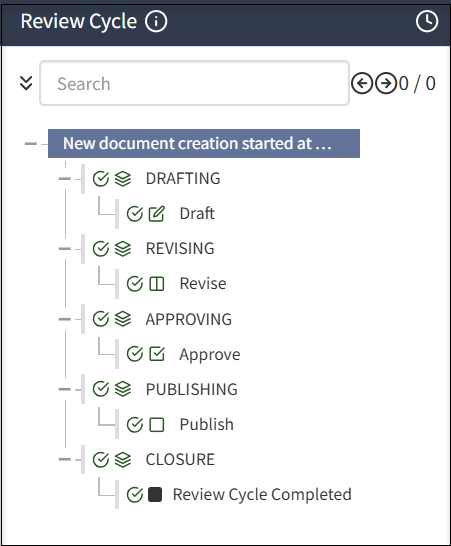
The document review cycle includes the following phases and phase-related tasks: DRAFTING, REVISING, APPROVING, PUBLISHING, and CLOSURE.
Best practice for managing review cycles
您可以根据任务(如审核者、审批者或其他操作)将个人分配到审核队列。例如,您的队列中可能有执行人力资源审核、人力资源审批、法律审核和法律审批的不同人员。通过这种方式,您可以在审核周期的适当阶段将文档分配给正确的人员。
文档审核的完整性取决于在审核特定文档时添加的层级或审核队列。
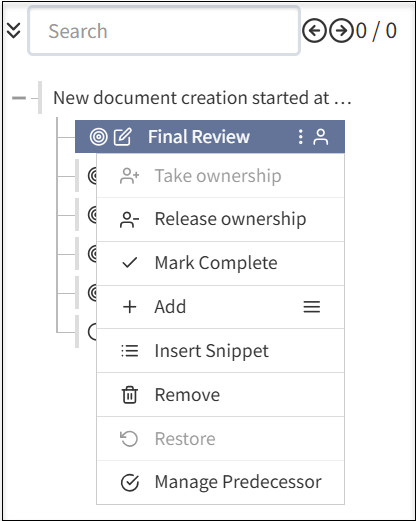
创建审核队列后,您可以执行以下操作:
- 通过分配人员或所属组来完成最终审核。
- 承接所有权:将其分配给自己以编辑文档。
- 释放所有权:不再编辑文档。
- 标记完成:将文档审核标记为完成。
- 添加:选择菜单图标以向文档中添加其他小节。附加步骤包括以下字段:
- 添加章节:向文档添加新章节以完成文档审核。
- 添加步骤:向文档中的现有章节添加新步骤。
- 添加编辑:向文档添加额外的编辑组件。
- 添加审批:在完成文档审核周期之前添加额外的审批层级。
- 添加修订:在标记为完成之前,添加额外的层级来修订文档。
- 添加关闭:在将文档标记为完成之前,添加额外的层级进行关闭。
- 插入片段:为文档添加片段。
- 移除:根据需要移除为文档添加的层级。
- 恢复:若在审核文档时意外删除了章节或层级,则恢复文档的历史版本。
- 管理前序任务:您可以在完成文档审核周期前分配前序任务。
建议您为文档所有权分配一个人员队列,为任务所有权分配另一个人员队列,以明确定义审核者、审批者和文档所有者。
It is recommended that Administrators select Enable Auto-assign to each phase of a review cycle to ensure someone has ownership.
Always close out a review cycle. If you do not, the cycle will appear to be open indefinitely. If you have a centralized policy team that manages policies, it is a best practice for that team to start (DRAFTING phase) and close out (CLOSURE phase) a review cycle. If you have a decentralized team, ensure that someone is responsible to close the review cycle.
Tasks in review cycle phases
In each phase, you can have any number and types of tasks. Certain types of tasks can only be added under certain phases, for example, approval task must under APPROVING phase.
The components of tasks in a review cycle includes the following:
- Checkmarks: Select the checkmark
 to complete phases and tasks.
 - Clock: Select the
 clock button to see the date and time for each completed phase.
 - Info: Select the
 info button to see the review flow assigned.
Drafting
In the DRAFTING phase, a document may be written for the first time, or reviewed at the start of a review cycle. To speed drafting, reusable content such as components and widgets can be used. After the DRAFTING phase is complete, the document moves to the next phase and does not return to the DRAFTING phase. For more information, see Creating a document.
Revising
In the REVISING phase, the document is iteratively reviewed and revised. Reviewers in a review queue add comments and may have rights to enter edits in the document. Multiple people are typically involved in a review and several iterations of the review are often required. If a change is made after earlier reviewers have approved the document, the system detects the change, resets the review cycle at the appropriate point, and notifies involved reviewers to view and approve the change.
The REVISING phase is complete when all reviewers have approved the same, final document. For more information, see Revising a document.
Approving
In the APPROVING phase, people in assigned queues examine the document and either approve or do not approve the document and comment on any issues. If the document is not approved, the system reopens the revising phase and notifies appropriate reviewers.
The system manages as many revising/approving cycles as necessary. The APPROVING phase is complete once all approvals are given. For more information, see Approving a document.
Publishing
In the PUBLISHING phase, the document cannot return to an earlier phase. Publishing a document can trigger dependent document review cycles. For more information, see Publishing a document.
Closure
In the CLOSURE phase, any business tasks related to ending the review cycle are executed and the review cycle is complete. The system will initiate a subsequent review based on the review frequency. For more information, see Publishing a document.
Off-cycle reviews
If a document needs to be updated before the next review date, you can start an off-cycle review. For more information, see Starting an off-cycle review.
Due dates and To Dos
At any point, you can select the Review Cycle tab then a task to view the Due by date and who the document will be routed to next in the right pane.
In To Do, select Add to add a reminder for the task and a due date, such as consult a colleague. You can also add notes. If you have active or pending To Do items, you cannot select the Done with Task to close the task.
